Parshat Vayeira: Connecting with your Emotions, Crying Out in Prayer (Word Study ‘za’akah)
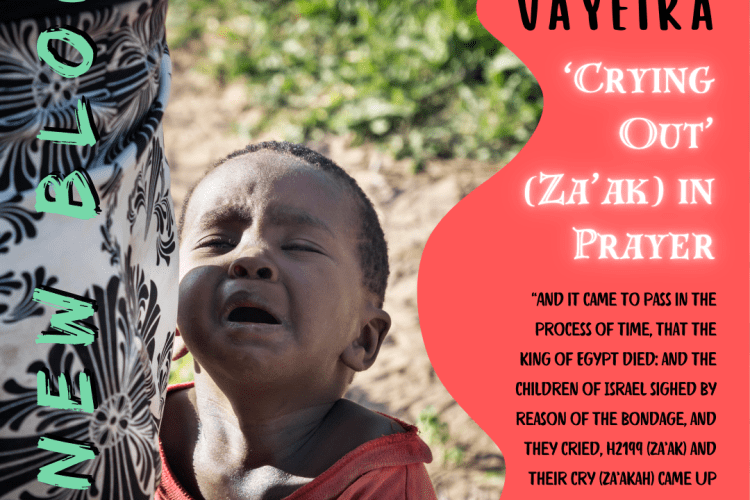
I was taught by an elder that when you pray, pray until the spirit wells up with you. That is, connect with your emotions when you pray – feelings of joy, sadness, fear, pain, remorse, etc. – in order to really ‘pour out your heart’ (Tehillim) and connect with Elohim. Having these kinds of honest conversations are how we break through in prayer.

In Torah last week (parshat Vayeira), we read that because the Children of Israel cried out in prayer ( za’aaku), they were heard on high:
- Exo 2:23 – “And it came to pass in the process of time, that the king of Egypt died: and the children of Israel sighed by reason of the bondage, and they cried, H2199 (Za’ak) and their cry (za’akah)came up unto Elohim by reason of the bondage.”
The Hebrew word used here is Za’ak, which means ‘to cry out, to shriek (from anguish or danger)’; ‘to cry out, exclaim, especially for sorrow, as complaining and imploring aid.’ (Strongs & Gesenius) https://www.blueletterbible.org/lexicon/h2199/kjv/wlc/0-1/
The definition of za’ak gives us more context to the depth of emotions the Israelites were pouring into their prayers. Synonyms for shriek are: scream, roar, howl, bellow, bawl, shout…. So, when it says the Israelites ’zaaku,’ it meant they were lifting up the kind of heart wrenching cries that a get your attention – shrieking, yelling, screaming, shouting even – to let the Almighty know the type of urgent danger they were in, and a desperate plea for help.
In context, the Israelites had a lot to cry out (za’ak) about, as they were victims of cruel and merciless slavery which came with every form of violence, injustice, dehuminization possible and worst of all – infanticide.

So, what was Elohim’s response to this kind of emotional pleading and crying out for help in prayer?
- ”7 And Hashem said, I have surely seen the oni ami (affliction of My people) which are in Mitzrayim, and have heard their cry (Za’akah) by reason of their nogesim (taskmasters); for I know their makhovim (sufferings); 8 And I am come down to deliver them out of the yad Mitzrayim, and to bring them up out of that land unto an eretz tovah, a spacious eretz zavat cholov udevash; unto the place of the Kena’ani, and the Chitti, and the Emori, and the Perizzi, and the Chivi, and the Yevusi.”
- “9 Now therefore, hinei, the cry of the Bnei Yisroel is come unto Me; and I have also seen the oppression wherewith the Egyptians oppress them. 10 Come now therefore, and I will send thee unto Pharaoh, that thou mayest bring forth My people the Bnei Yisroel out of Mitzrayim.”
Of course, Elohim – being the loving Father that He is – heard the heart wrenching cries (za’akah) of His people and sent Moshe to deliver them (hatzal) (rescue), yeshua (save), hatza’ah (bring out) – to freedom (chuf’sha) from the pangs of captivity.

The Tehillim further testify of this truth, that the Almighty hears the cries (za’akah) of His afflicted:
“For he shall deliver the evyon (needy) when he crieth (za’akah); the oni (poor, afflicted) also, and him that hath no ozer (helper). He shall pity the weak and evyon (needy), and yoshi’a (he shall save) the nefashot of the evyonim (needy). He shall be the Go’el Redeemer of their nefesh from deceit and chamas; and precious shall their dahm be in his sight.” Tehillim 72:12-14 TOJB2011
In conclusion, the next time when you or your people are in the throes of distress, remember how the Israelites cried out (za’aku) before Elohim with all their emotions. Or Whether it be extreme joy or pain, let the example of our ancestors guide you in prayer by stirring up the spirit of your soul with the ancient practice of pouring out your sincere heartfelt emotion before the One who hears sincere prayers of the afflicted and saves – YHWH יהוה אלוהי השמיים.
1❤️💛💚
If you found this blog enlightening, please share it with a friend, follow me on social media, or visit queenmakedah.com to book, download music, take Hebrew classes or support the work.