Parshat Vayeira:  Connecting with your Emotions, Crying Out in Prayer (Word Study ‘za’akah)
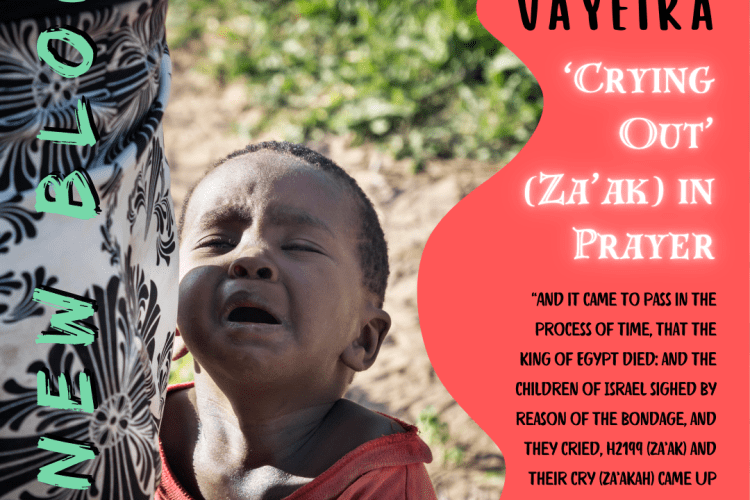
I was taught by an elder that when you pray, pray until the spirit wells up with you.   That is, connect with your emotions when you pray – feelings of joy, sadness, fear, pain, remorse, etc. – in order to really ‘pour out your heart’ (Tehillim) and connect with Elohim.  Having these kinds of honest conversations are how we break through in prayer.

In Torah last week (parshat Vayeira), we read that because the Children of Israel cried out in prayer ( za’aaku), they were heard on high:

  • Exo 2:23 – “And it came to pass in the process of time, that the king of Egypt died: and the children of Israel sighed by reason of the bondage, and they cried, H2199 (Za’ak) and their cry (za’akah)came up unto Elohim by reason of the bondage.”

The Hebrew word used here is Za’ak, which means ‘to cry out, to shriek (from anguish or danger)’; ‘to cry out, exclaim, especially for sorrow, as complaining and imploring aid.’ (Strongs & Gesenius) https://www.blueletterbible.org/lexicon/h2199/kjv/wlc/0-1/ 

The definition of za’ak gives us more context to the depth of emotions the Israelites were pouring into their prayers.  Synonyms for shriek are:  scream, roar, howl, bellow, bawl, shout…. So, when it says the Israelites ’zaaku,’ it meant they were lifting up the kind of heart wrenching cries that a get your attention – shrieking, yelling, screaming, shouting even –  to let the Almighty know the type of urgent danger they were in, and a desperate plea for help.  

In context, the Israelites had a lot to cry out (za’ak) about, as they were victims of cruel and merciless slavery which came with every form of violence, injustice, dehuminization possible and worst of all – infanticide.  

So, what was Elohim’s response to this kind of emotional pleading and crying out for help in prayer?  

  • ”7 And Hashem said, I have surely seen the oni ami (affliction of My people) which are in Mitzrayim, and have heard their cry (Za’akah) by reason of their nogesim (taskmasters); for I know their makhovim (sufferings); 8 And I am come down to deliver them out of the yad Mitzrayim, and to bring them up out of that land unto an eretz tovah, a spacious eretz zavat cholov udevash; unto the place of the Kena’ani, and the Chitti, and the Emori, and the Perizzi, and the Chivi, and the Yevusi.”
  • “9 Now therefore, hinei, the cry of the Bnei Yisroel is come unto Me; and I have also seen the oppression wherewith the Egyptians oppress them. 10 Come now therefore, and I will send thee unto Pharaoh, that thou mayest bring forth My people the Bnei Yisroel out of Mitzrayim.”

Of course, Elohim – being the loving Father that He is – heard the heart wrenching cries (za’akah) of His people and sent Moshe to deliver them (hatzal) (rescue), yeshua (save), hatza’ah (bring out) – to freedom (chuf’sha) from the pangs of captivity.

The Tehillim further testify of this truth, that the Almighty hears the cries (za’akah) of His afflicted:

“For he shall deliver the evyon (needy) when he crieth (za’akah); the oni (poor, afflicted) also, and him that hath no ozer (helper). He shall pity the weak and evyon (needy), and yoshi’a (he shall save) the nefashot of the evyonim (needy). He shall be the Go’el Redeemer of their nefesh from deceit and chamas; and precious shall their dahm be in his sight.” ‭‭Tehillim‬ ‭72‬:‭12‬-‭14‬ ‭TOJB2011‬‬

In conclusion, the next time when you or your people are in the throes of distress, remember how the Israelites cried out (za’aku) before Elohim with all their emotions.  Or Whether it be extreme joy or pain, let the example of our ancestors guide you in prayer by stirring up the spirit of your soul with the ancient practice of pouring out your sincere heartfelt emotion before the One who hears sincere prayers of the afflicted and saves – YHWH יהוה אלוהי השמיים.

1❤️💛💚

If you found this blog enlightening, please share it with a friend, follow me on social media, or visit queenmakedah.com to book, download music, take Hebrew classes or support the work.

PARSHAT CHAYEI SARAH: Rivkah’s Water Test – Seeking Eshet Chayil (a Proverbs 31 Woman)

“O YHWH, Elohai of my master, Abraham,” he prayed. “Please give me success today, and show unfailing love to my master, Abraham. See, I am standing here beside this spring, and the young women of the town are coming out to draw water. This is my request. I will ask one of them, ‘Please give me a drink from your jug.’ If she says, ‘Yes, have a drink, and I will water your camels, too!’—let her be the one you have selected as Isaac’s wife. This is how I will know that you have shown unfailing love to my master.”

‭‭Genesis‬ ‭24‬:‭12‬-‭14‬ ‭NLT‬‬

Eliezer had a very important task – to find a wife suitable for his master Abraham‘s son, Yitzchak.  Now Abraham was not an ordinary man but was an anointed servant of Elohim whose seed was called to be a great priestly nation of El Elyon. This promise of nationhood was dependent upon  several elements, one of which was strong families.  So, finding a suitable wife for Yitzchak was of utmost importance.

What virtues was Eliezer seeking in a potential  bride for Yitzchak?  His water test shows us he was looking for a woman who had the virtues of an Eshet Chayil (a virtuous woman) [haritzute (diligence) and nedivute (generousity)]

Harutzah

An Eshet Chayil (described in Pr. 31) is harutzah – hardworking, diligent and industrious. 

She selects wool and flax
    and works with eager hands.
14 She is like the merchant ships,
    bringing her food from afar.
15 She gets up while it is still night;
    she provides food for her family
    and portions for her female servants.
16 She considers a field and buys it;
    out of her earnings she plants a vineyard.
17 She sets about her work vigorously;
    her arms are strong for her tasks.
18 She sees that her trading is profitable,
    and her lamp does not go out at night.
19 In her hand she holds the distaff
    and grasps the spindle with her fingers.

Because the responsibility of caring for her family is upon her shoulders (along with her husband), she can’t afford to be lazy or idle.  Rather, she burns the midnight oil – rises early and stays up late to plant, sew, knit, weave fabric, prepare products to buy and sell… whatever it takes to provide food and clothing for her loved ones. 

“She seeks wool and flax, and works with willing hands. She is like the ships of the merchant; she brings her food from afar. She rises while it is yet night and provides food for her household and portions for her maidens.

She considers a field and buys it; with the fruit of her hands she plants a vineyard. She dresses herself[e] with strength and makes her arms strong. She perceives that her merchandise is profitable. Her lamp does not go out at night.

She puts her hands to the distaff, and her hands hold the spindle. She makes linen garments and sells them; she delivers sashes to the merchant.” 

Pr. 31.10-19, 24

Although Rivkah was a single woman, Eliezer would have been looking for qualities of an isha harutzah like the proverbs 31 woman.  

In the water test, Eliezer says:  ‘Let her say: ‘Yes, have a drink, and I will water your camels, too!’  What was his objective? What character traits was he looking for?

It would be easy for a young lady to give a sip of water from her jug to a thirsty stranger if she’d already filled it, but for a woman to volunteer herself to take many more trips down to the spring to give water to his camels… Well, that would mean this woman was cut from a different cloth, demonstrating harituze (dilligence), nedivute, and more.  

Camels drink a lot of water, so it would take a lot of energy, strength and sheer will power to go back and forth to the spring, lifting and hauling water jugs for his camels.  Yet, this was exactly what she did.  Hands down, Rivkah was harutzah like the eshet chayil we read about in Proverbs 31 (not atzlanite or lazy). 

Nedivah 

An eshet chayil is nedivah – a generous woman with a big heart who gives willingly and freely to the members of her household including servants and the poor and destitute of her community. 

‘She rises while it is yet night and provides food for her household and portions for her maidens.’  Pr. 31.15

‘She opens her hand to the poor and reaches out her hands to the needy.’ Pr. 31.20

‘She is not afraid of snow for her household, for all her household are clothed in scarlet.’

The virtuous woman works willingly with her hands, showing nedivute. That means she has a mindset to give and she gives freely – not only to her family but also to her servants and the poor and needy.

The water test allowed Eliazar to see this part of Rivkah’s nature as well.  She was not just hard-working (haritzah) but she was also kind and generous (nedivah) because she gave willingly spontaneously and freely to both Eliezer, a complete stranger, and to his camels who were also thirsty and in need.

She went further to extend an invitation for them to take lodging at her father‘s estate, extending even more acts of kindness. This shows that Rivkah’s generosity came from a place of compassion, mercy, and concern for the stranger and for animals who were in need.

Yirat Elohim

Charm is deceitful, and beauty is vain, but a woman who fears YHWH (yirat ha Shem) is to be praised.”  (Pr. 31.30)

All in all, an Eshet Chayil has yirat Elohim, which means to fear or revere of the Most High.  When you fear the Almighty, you keep His commands and His commands are to love the Creator with all your heart and love your neighbor as thyself.  So, a virtuous woman – like Rivkah and in Prov. 31 – works hard and gives generously to those in need, not because she is motivated by money, power or selfish gain, but rather she does acts of kindness out of sincere love and concern for her family and the people of her community. 

In sum, Rivkah wore the crown of the virtuous woman (eshet chayil) royally, which made her the perfect match for Yitzchak and sealed her place as one of the great matriarchs of the nation of Israel.

These historical stories are not just to share historical facts with us but to inspire and guide our daily walk in Elohim.  

Reflection: Am I an ‘eshet chayil’ woman (or an ‘ish chayil’ man for brothers)?  How can I become more perfect in my walk with Elohim?   Prayer: Pray for more of these powerful spiritual attributes and Yah to strengthen and guide you.

One Love and Blessings! Makedah

Feel free to share this blog and remember to sign up for the mailing list for the latest inspired writings!

To support my work, consider becoming a patron or a donor. All info is on the donation page of my artist website here.

Subscribe to our newsletter!

[newsletter_form type=”minimal”]

PARSHAT VAYEIRA: Abraham’s Big Heart – Nedivut (Generosity) & the 3 Visitors

How many times have you turned away a would be visitor because you weren’t prepared?  Or how many times have you begrudgingly prepared for guests or for a gathering or family, friends or co-workers?  How many times have you allowed someone else to carry the burden of food preparation or other work needed to accommodate guests, or complained about your workload?

We’ve probably all been guilty ar some point and I’ll be the first to admit it.  According to Hebraic thought, the attribute we were lacking is called ‘nidivoot,’ or a heart that is willing to give freely and spontaneously.  Today we refer to this trait as generous or charitable.  

But in scripture, this is more than throwing a few shekels into your favorite charity cup or to a local beggar.  To be nadeev is someone who is quick to volunteer their help willingly, freely and spontaneously.  A person who is nadiv has a big and kind heart, not because they stand to gain something in return but because that’s their nature or Elohim put it in their heart to feel that way.

This attribute of nedivut is best demonstrated by father Abraham in Bereshit chapter 18:

Spontaneously willing to help

“Abraham looked up and saw three men standing nearby. When he saw them, he hurried from the entrance of his tent to meet them and bowed low to the ground. 3 He said, “If I have found favor in your eyes, my master,[a] do not pass your servant by.”

We see here that the 3 visitors were not expected nor known, yet Abraham jumped up and hurriedly greeted them with respect.  The visitors didn’t ask Abraham for assistance , but he volunteered willingly.

Kindheartedness 

4 Let a little water be brought, and then you may all wash your feet and rest under this tree. 5 Let me get you something to eat, so you can be refreshed and then go on your way—now that you have come to your servant.” Gen. 18:4-5

Travelers on a long journey in the desert can easily run out of essentials and would be exhausted from being in the sun for long periods of time.  Abraham showed concern for these visitors by urging them to come and refresh themselves under his tree and get some much needed food and drink.  This could have easily been a life saving gesture, and Abraham moved with urgency.

Gave Freely

“So Abraham hurried into the tent to Sarah. “Quick,” he said, “get three seahs[b] of the finest flour and knead it and bake some bread.7 Then he ran to the herd and selected a choice, tender calf and gave it to a servant, who hurried to prepare it.” Gen. 18:6-7

Abraham could have easily given these men some dried fruit and water and sent them on their way.  But he went out of his way to prepare fresh bread, cheese and the choicest of his herds for them – a feast.  This was probably made in the form of an eastern style beef stew with warm flat bread and crumbled feta and olive oil.  He went all out to roll out the red carpet for these strangers making them a true feast fit for kings and got Sarah and the youth to help him.  He certainly gave freely.

“8 He then brought some curds and milk and the calf that had been prepared, and set these before them. While they ate, he stood near them under a tree.” Gen. 18:8

Finally, Abraham not only served these messengers of Elohim, but he stood nearby while they ate, showing he was ‘ready for anything’ as it says in Gesenius Lexicon.  If they wanted more or needed anything else, he was near and willing to give until they were satisfied.

What a jewel Abraham was!  He was certainly an ish nadeev after Elohim’s heart!  Abraham served Elohim, his family and people with all his heart.  Some say he showed nidivoot even when he still recovering from circumcision, which would give even further perspective to the depth of his character.  Because he gave so abundantly, he received abundantly and visa versa.  

How can we bring more nedivut into our daily walk?

Recent studies show people who practice generosity and acts of kindness live healthier longer lives.

Thanks for reading!

Blessed week to you and yours! Queen Makedah

If you’d like to support my work, listen to my music or take a Hebrew class with me, click here to visit my artist website.

Please sign up on the contact page for more blogs and music news and connect on social media. 1❤️💛💚

‘Lay Down Your Guns’ – Youth Caught in Crossfire

‘Lay Down Your Guns’ Backstory (part 1) – Youth Caught in Crossfire

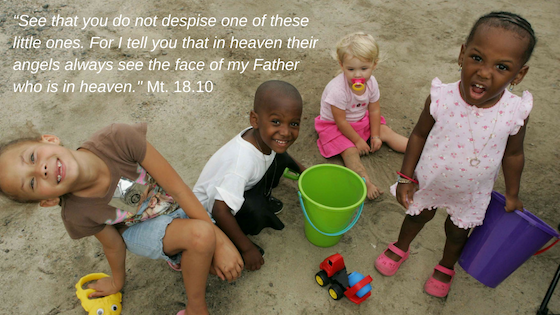
Children quote Mt. 18.10

When my family came back to the U.S. from Israel over ten years ago, we settled in the Bay Area of California.  At that time, Richmond and Oakland were leading the country as two of the most violent cities in America to live in.  So, as strange as it sounds, I went through a period of ‘gun violence culture shock.’  You see, I had lived in Israel a number of years during a time of peace, where life was pretty simple.  

Back then, kids in Israel could run and play carefree around the neighborhood without fear.  And although this privilege was abused by some (i.e. ‘Where is that child’s mama?’), it was no small matter that you as a parent never had to worry about someone snatching your child off the street – or just as terrifying – your baby getting intentionally murdered or caught in the crossfire of gang or street violence.

So, fast forward Babylon, headlines here were filled with the horror of young black and brown faces whose young lives were being snuffed out in showers of gunfire, caught in the crossfire of bloody gang terrorism or outright assassinated.  It was horrifying! And As families mourned their children, their grief was often compounded by a code of silence in the community that deadlocked any real convictions.  

This was the bloody landscape that gave birth to the lyrics of the original version of ‘Lay Down Your Guns.’  

Lay Down Your Guns – Verse One:

“Let the innocent (man’s soul) go free
Blessed be the man of peace
Cursed be the wicked, prey upon the weak
Let all this war and fighting cease”

The first line of the song says, ‘Let the innocent go free.’  Who are the innocent? All unarmed civilians are innocent.  Yet, our youth are the most vulnerable and innocent of all. It is our job to protect them, yet they are paying the worst price for this country’s insatiable lust for guns.

Screen Shot 2018-12-12 at 1.35.36 PM
8-year-old Alaysha Carradine. CBS News 10/02/2013

The precious little face of 8-year-old Alaysha Carradine is hard to forget.  This sweet little girl, lovingly called ‘Ladybug’ by her family, was killed in 2013 during a sleepover at a friend’s house when a gang member rang the doorbell and riddled the apartment front door with gunfire as she walked toward it.   Although her killers have been caught and sentenced, the mother and family will live with this trauma forever. 

Sadly, a shocking 21 children under the age of 17 were caught in crossfire and lost their lives to gun violence in Oakland to  from 2011 to 2013.  During this time, Lay Down Your Guns was written.   Insanly, some of these 21 children were literally babies.

Screen Shot 2018-12-12 at 1.39.47 PM
Carlos Nava and Hiram Lawrence, Jr. CBS News 12.16.2011.

In 2011, 23-month-old Hiram Lawrence Jr. was shot in the head by a stray bullet while sitting in a car with his father during the filming of a rap video.  In that same year, 3-year-old Carlos Nava was killed in a drive by shooting, while his mother pushed him in a stroller on a two-block walk home on International Boulevard from the store.

If the facts and faces of these children does not stir your emotions,  then you may not have a pulse at all.  But we need to do more than just feel the depth of this tragedy, we must do something NOW!  Lay down your weapons and push for gun control laws that make sense.   The article ‘What can I do about Gun Control,’ from The Cut will give you some solid answers on how you can become active for this important crucial cause – gun control.

Here’s the first version of the song Lay Down Your Guns over the Wailer’s ‘Lively Up Yourself’ Riddim, from Reggae Gyal’s International Women’s Day Concert at Pier 23 in San Francisco feat. Queen Makedah and the Sheba Warriors Band:

Lay Down Your Guns only begins to channel the collective emotional trauma of  the mothers and fathers, the youth, and the communities suffering from this plague, who are crying out to mankind, ‘Lay down your guns!’  My prayer is that this song will inspire you and many to do just that, put down your weapons and work for peace.  

You can also support my new album.  A remix of ‘Lay Down Your Guns’ is one of the final songs to be recorded for the ‘Peace Process’ album to finally be released in Spring of 2019.  If you’d like to contribute to the album, visit the Peace Process Go Fund Me page.

Make sure you sign up for for Queen Makedah’s mailing list to keep up with the latest music news, blogs, videos, live performances and more at www.queenmakedah.com

Reference:  

Caught in the Crossfire,’ Mercury News, 08/07/2013.

https://www.mercurynews.com/2013/08/07/caught-in-the-crossfire-21-children-have-been-shot-and-killed-in-oakland-since-2011/